

Dubai Business Setup Guides – The Complete Blueprint for Entrepreneurs in the UAE
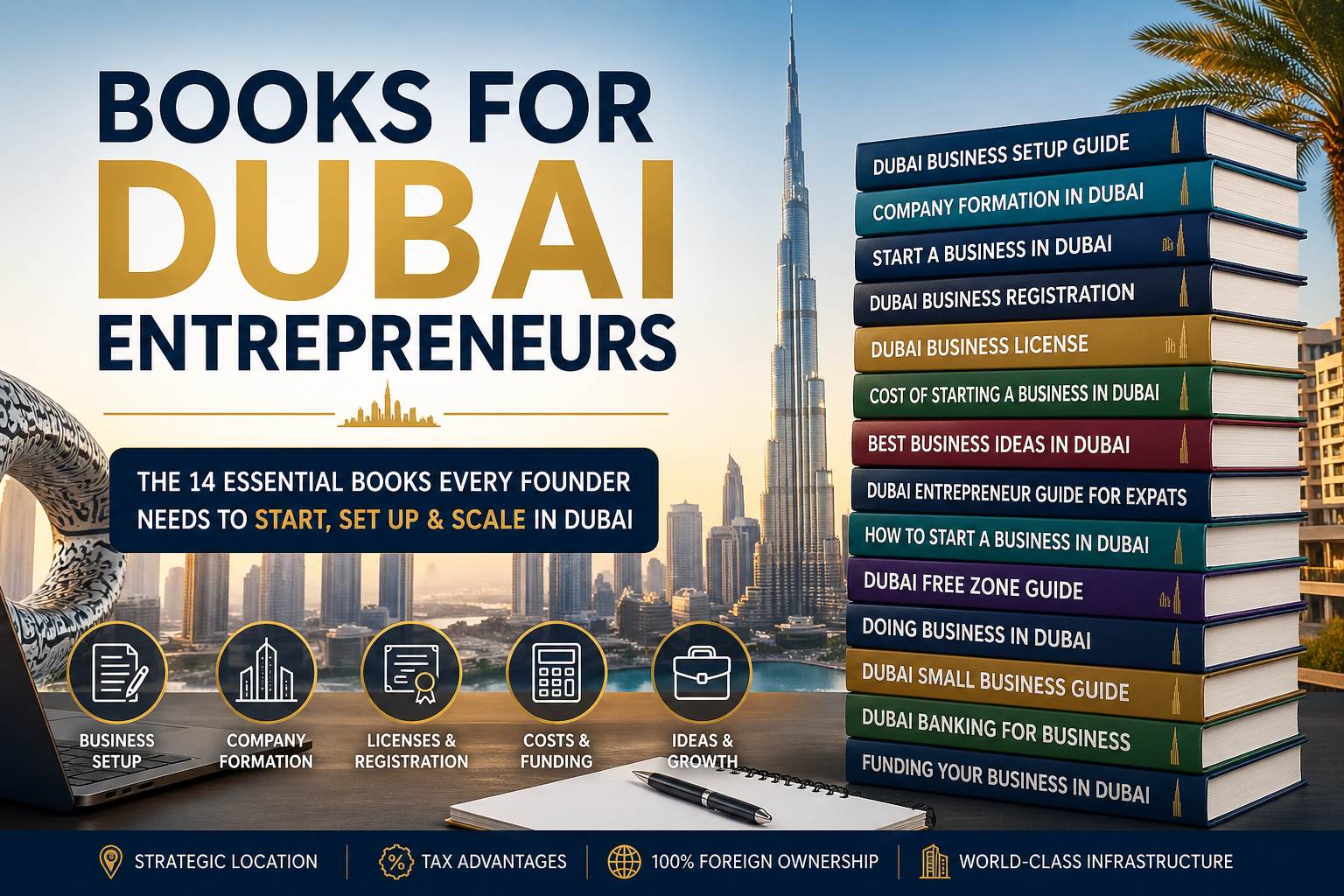
Essential Reading: 14 Books for Dubai Entrepreneurs
- Dubai Business Setup
- Company Formation in Dubai
- Start a Business in Dubai
- Dubai Business Registration
- Dubai Business License
- Cost of Starting a Business in Dubai
- Best Business Ideas in Dubai
- Dubai Entrepreneur Guide for Expats
- How to Start a Business in Dubai
- Mainland vs Free Zone Company Dubai
- Dubai Free Zone Company Guide
- Dubai Investor Visa Guide
- Opening a Business Bank Account in Dubai
- How to Start a Business in Dubai with No Money
Dubai has established itself as one of the world’s most strategically significant business destinations. For entrepreneurs, investors, and ambitious founders seeking to build scalable enterprises, Dubai offers an ecosystem that combines tax efficiency, regulatory modernization, global connectivity, and investor credibility. Yet while opportunity is abundant, successful market entry requires far more than registering a company. Building a business in Dubai demands strategic planning, legal precision, financial readiness, and operational sophistication.
For modern founders, Dubai is not merely a location for business registration—it is an entrepreneurial operating system. The emirate provides access to regional and international markets across the GCC, Asia, Europe, and Africa while offering world-class logistics, advanced infrastructure, and increasingly founder-friendly reforms. However, entrepreneurs who approach Dubai casually often encounter avoidable structural challenges, including licensing inefficiencies, banking delays, regulatory friction, or poor jurisdiction selection.
This guide presents a comprehensive blueprint for entrepreneurs seeking to establish, structure, and scale businesses in Dubai effectively.
Understanding Dubai’s Strategic Entrepreneurial Advantage
Dubai’s economic transformation has positioned it as a premier global commercial hub. Entrepreneurs are drawn to Dubai for several foundational reasons.
First, the tax environment remains one of the most attractive globally. While corporate tax frameworks have evolved, Dubai continues to offer substantial optimization advantages relative to many Western jurisdictions. Personal income tax remains absent, and free zones can provide highly competitive tax efficiencies depending on business activity and structure.
Second, Dubai’s geographic position creates extraordinary logistical leverage. A business headquartered in Dubai can efficiently serve clients across the Middle East, Africa, Europe, and Asia. For international founders, this geographic advantage translates into operational reach and market diversification.
Third, Dubai’s government has consistently prioritized economic diversification. This creates strong opportunities across sectors such as:
- Technology and AI services
- eCommerce
- Logistics
- Real estate
- Tourism
- Financial services
- Professional consulting
- Education and training
Fourth, investor confidence in Dubai remains high due to political stability, infrastructure maturity, and transparent commercial development.
For entrepreneurs, these factors collectively create a compelling business environment—but only when navigated strategically.
Step One: Define Your Business Model and Market Opportunity
Before entering Dubai’s regulatory framework, entrepreneurs must validate their business concept.
This includes:
Market Research
Dubai’s diverse economy includes local Emirati consumers, expatriate populations, global corporations, tourists, and regional investors. Understanding target demographics is essential.
Entrepreneurs should assess:
- Customer demand
- Competitive intensity
- Pricing models
- Regulatory barriers
- Consumer behavior patterns
- Sector-specific scalability
For example, a digital marketing agency targeting SMEs may require significantly less capital and regulatory complexity than a hospitality venture or logistics operation.
Revenue Architecture
Founders must determine whether their business is:
- Service-based
- Product-based
- Digital-first
- Trading-focused
- Consulting-oriented
- Subscription-driven
This impacts licensing, operational costs, and banking considerations.
Dubai rewards entrepreneurs who align business models with both market demand and structural efficiency.
Step Two: Choose the Right Business Jurisdiction
One of the most critical decisions in Dubai business setup is selecting the correct jurisdiction.
The three primary categories include:
Mainland Companies
Mainland businesses are licensed through Dubai’s Department of Economy and Tourism and provide broad operational flexibility within the UAE market.
Advantages:
- Ability to trade directly across the UAE
- Eligibility for government contracts
- Greater physical market reach
- Broad sector compatibility
Challenges:
- Higher compliance obligations
- Potentially greater setup costs
- More complex administrative processes
Mainland is often optimal for retail, hospitality, construction, or businesses requiring unrestricted UAE access.
Free Zone Companies
Dubai’s free zones offer specialized ecosystems for entrepreneurs seeking speed, ownership control, and tax advantages.
Benefits:
- 100% foreign ownership
- Simplified incorporation
- Lower entry barriers
- Streamlined visa systems
- Sector specialization
Popular free zones include:
- DMCC
- IFZA
- Dubai South
- Meydan Free Zone
- DIFC
- Dubai Internet City
Free zones are especially attractive for:
- Consultants
- eCommerce founders
- digital agencies
- holding companies
- international service businesses
Limitations:
- Restrictions on certain mainland operations
- Jurisdiction-specific activity constraints
Offshore Structures
Offshore entities may serve strategic roles for asset holding, international structuring, or tax planning, though they are less relevant for direct operational businesses.
Choosing the wrong jurisdiction can increase costs, reduce scalability, and complicate banking.
Step Three: Select the Appropriate Legal Structure
Legal structure affects liability, taxation, ownership, and operational flexibility.
Common structures include:
- Sole establishment
- Limited Liability Company (LLC)
- Civil company
- Free zone establishment (FZE)
- Free zone company (FZCO)
- Branch office
Entrepreneurs should evaluate:
- Number of shareholders
- Liability protection
- Capital requirements
- Investor compatibility
- Visa quotas
- Banking perception
For most scalable businesses, structure should prioritize both operational efficiency and long-term investor credibility.
Step Four: Business Registration and Licensing
Once strategic decisions are finalized, founders enter the registration process.
Core Registration Steps:
- Trade name reservation
- Initial government approval
- Business activity classification
- Legal document drafting
- Office or flexi-desk arrangements
- License issuance
- Immigration registration
- Tax and compliance setup
Licensing Categories
Selecting the right license is foundational.
Commercial License
For trade, import/export, and product sales.
Professional License
For consulting, agencies, freelancers, and services.
Industrial License
For manufacturing or industrial operations.
Tourism License
For hospitality or travel-related ventures.
eCommerce License
For online-first businesses.
Improper activity selection can delay approvals, create compliance issues, or restrict operations.
Step Five: Understand Real Business Setup Costs
Dubai business setup costs vary significantly depending on structure, industry, and scale.
Typical Cost Categories:
- Trade license fees
- Government approvals
- Visa costs
- Office leasing
- Immigration cards
- Emirates ID processing
- Medical tests
- Bank deposits
- Legal drafting
- Insurance
Estimated Startup Cost Ranges:
Lean Free Zone Models:
AED 12,000–25,000+
Standard Professional Businesses:
AED 20,000–50,000+
Trading or Industrial Companies:
AED 50,000–250,000+
Hidden Costs Often Overlooked:
- Renewals
- Accounting
- VAT support
- Payroll systems
- Merchant accounts
- Website infrastructure
- Marketing
- Staff scaling
A common founder mistake is undercapitalization. Dubai’s premium business environment requires realistic runway planning.
Step Six: Open a Corporate Bank Account
Banking remains one of the most underestimated components of Dubai entrepreneurship.
Corporate banking approval depends on more than registration alone.
Banks evaluate:
- Business legitimacy
- Shareholder transparency
- Revenue model clarity
- Compliance standards
- Operational documentation
Required Documentation Often Includes:
- Trade license
- MOA
- Shareholder passports
- Visa copies
- Business plans
- Proof of address
- Contracts or invoices
Strategic Banking Priorities:
- Multi-currency support
- International wire capabilities
- Merchant services
- Digital banking tools
- Reputation
- Sector compatibility
Entrepreneurs should design their business to be bankable from inception.
Step Seven: Secure Investor or Entrepreneur Residency
Dubai investor visas provide entrepreneurs with more than operational legality—they offer lifestyle infrastructure.
Benefits:
- UAE residency
- Family sponsorship
- Banking facilitation
- Regional mobility
- Long-term market integration
Visa pathways vary by jurisdiction, investment size, and ownership structure.
For expat entrepreneurs, visa strategy should align with both business and personal residency goals.
Step Eight: Build Operational Infrastructure
Registration alone does not create business success.
Entrepreneurs must establish:
- Branding
- Website infrastructure
- CRM systems
- Accounting systems
- Tax compliance
- Customer acquisition strategies
- HR systems
- Sales funnels
Dubai’s competitive ecosystem rewards businesses that professionalize rapidly.
This is especially true in sectors such as:
- AI consulting
- Digital marketing
- Professional services
- Real estate
- Education
- Financial services
Step Nine: Choose High-Growth Sectors Strategically
Dubai offers broad entrepreneurial opportunities, but strategic founders focus on sectors with defensible economics.
High-Potential Industries:
eCommerce
Strong logistics and digital adoption.
AI & Automation
Rapidly growing demand across SMEs and enterprise sectors.
Digital Services
Low overhead and scalable international potential.
Real Estate Services
Persistent demand and premium margins.
Education & Professional Training
Growing market for specialized expertise.
Tourism & Luxury Services
Global city positioning supports premium business models.
The best business idea is not necessarily the cheapest to launch—it is the one with the strongest scalability, demand, and defensibility.
Step Ten: Scale Beyond Setup
True entrepreneurial success in Dubai comes from moving beyond registration into systematic scaling.
Scaling Priorities:
- Customer acquisition systems
- Team building
- Capital reinvestment
- Strategic partnerships
- International expansion
- Brand authority
- Operational automation
Dubai founders who succeed long-term typically treat setup as Phase One, not the end goal.
Common Entrepreneurial Mistakes in Dubai
Despite Dubai’s advantages, founders frequently make avoidable mistakes.
Common Errors:
- Choosing the wrong jurisdiction
- Underestimating banking complexity
- Insufficient capital reserves
- Poor activity selection
- Compliance neglect
- Overreliance on low-quality consultants
- Lack of market validation
- Weak customer acquisition planning
Entrepreneurs who approach Dubai with investor-grade discipline outperform those who view setup as a simple administrative task.
Dubai for Expats: Unique Advantages and Considerations
Dubai remains one of the world’s most expat-friendly entrepreneurial ecosystems.
Advantages:
- International ownership opportunities
- Modern infrastructure
- Global talent access
- Residency options
- Premium business reputation
Challenges:
- Cultural adaptation
- Banking scrutiny
- Regulatory learning curves
- Network limitations
Expats who proactively build local networks and regulatory knowledge create stronger long-term businesses.
Final Strategic Blueprint: Building Enterprise Value in Dubai
Dubai is one of the world’s most compelling entrepreneurial jurisdictions, but success is not automatic.
Winning founders approach Dubai through strategic architecture:
- Validate demand
- Choose the right structure
- License accurately
- Capitalize adequately
- Build bankability
- Secure residency
- Execute operationally
- Scale intelligently
The entrepreneurs who thrive in Dubai are not merely company owners. They are strategic operators who understand that business setup is only the first layer of enterprise building.
Dubai offers extraordinary upside for founders prepared to combine knowledge with disciplined execution.
For entrepreneurs seeking to build serious wealth, scalable businesses, and long-term enterprise value, Dubai is not simply a market.
It is one of the world’s most powerful business launchpads.